The Grids
2 minute read
November 4, 2026

Andrew Gillick
Managing Director, Director of Research
The Grids
The U.S. ‘grid’ is a patchwork of regional systems that runs well below capacity. The rush to secure power is driving up asset prices, but growing demand doesn’t guarantee attractive returns. The cheapest new megawatt might be the one the grid already has but can’t deliver.
Everyone says our grid is old and there isn’t enough power to handle all the demand. But what if I told you that average output from America’s power plants is only about half of installed capacity? That’s right, the grid is built for the highest demand periods of the year which is only a handful of peak days. The rest of the time, some plants run constantly, some depend on the weather, and others sit idle between peaks, doing their best impression of a snowplow in Washington DC, ready for the one day a year you might need it.
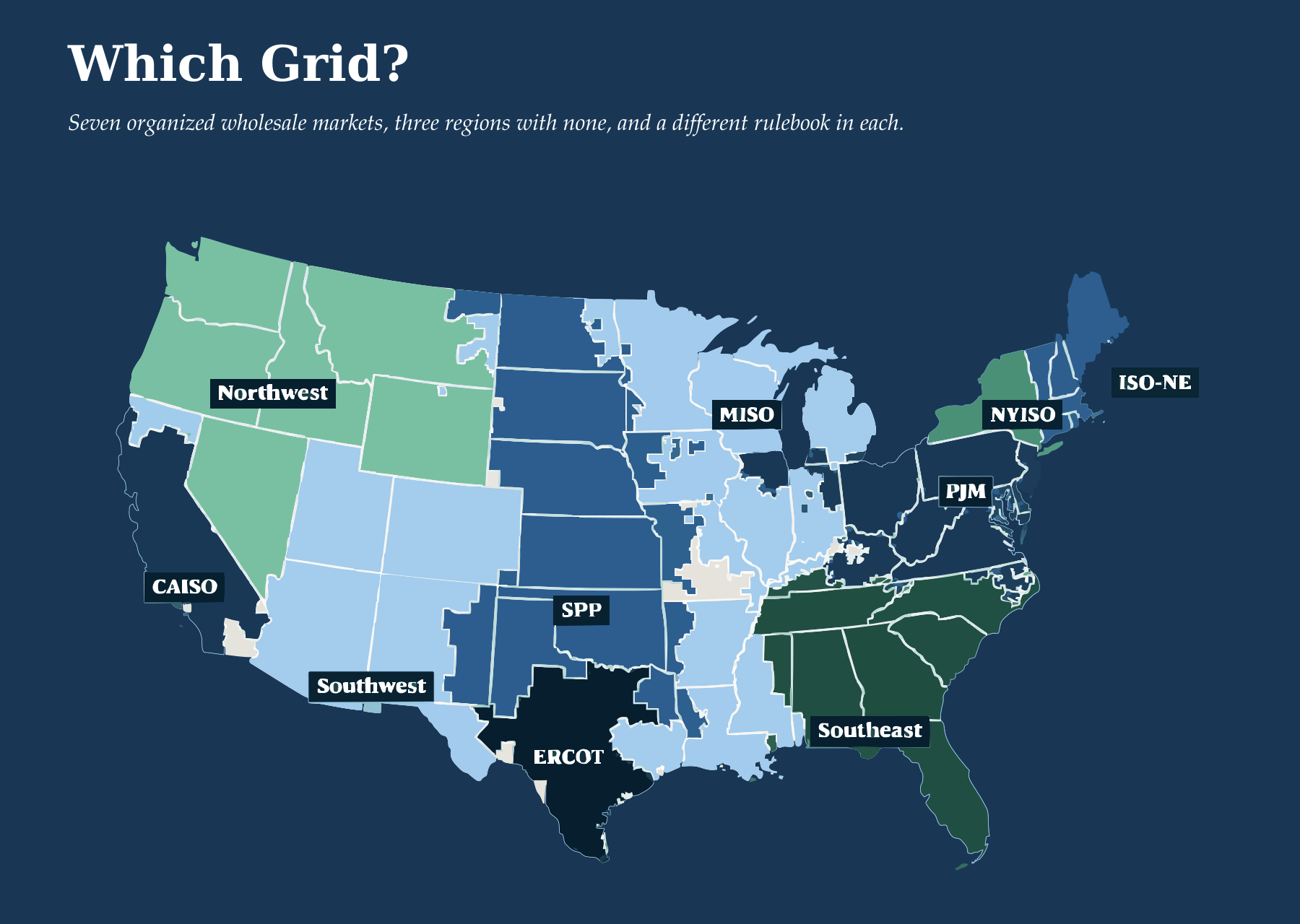
To be clear, the grid is not just power supply. It is a complex network of generation, transmission, substations and transformers, and finally, distribution. This, all separated into independent operating regions, with different rules. The best part is nobody ever designed a national grid. In 1882, Thomas Edison turned on Pearl Street Station in lower Manhattan and little grids followed all over the country. Alternating current let them grow, and holding companies started rolling up the businesses, with states regulating the local monopolies. Then, in 1935, Washington stepped in to regulate power moving across state lines and break up sprawling holding companies into regional businesses that regulators could actually oversee. The postwar boom brought bigger plants and more connections because sharing power was cheaper than going it alone. Then PURPA in 1978 and the reforms of the 1990s opened the door to competing generators. And here we are today with a patchwork of regional systems, different rules, and a whole bunch of spare capacity on your average day.
So next time someone tells you something about the grid, maybe ask which one.
As power demand started to grow over the last five years, factories, EV charging networks, crypto miners, and now data centers went looking for places where the system already had available capacity. Those locations attracted attention fast. Then the scramble expanded: find an old plant that could be brought back, get in line for equipment to build a new one, or for the most impatient, go behind the meter and bring your own power. And here we are today, with everyone talking about the queue. No, not a line outside a London bakery, but the wait to get power supplied to a new customer or get a new power plant connected. After a generation of little power demand growth, our friends, “the grids,” need upgrades to connect new generation and serve enormous new customers, often in places the existing wires weren’t built to handle. And so we wait.
For investors, this means opportunities can look very different a few miles down the road from each other. One location needs a new power plant. Another needs a bigger substation or a transmission upgrade to access power that already exists. Somewhere else, a battery storage project could unlock supply or a customer willing to reduce consumption during peak hours can put more of the existing system to work. Those are all different investments, with different costs, timelines, and risks.
The headline demand for power is driving up prices of anything that looks like available electrons. Prices for operating gas plants are around multiples higher than they were just four years ago because everyone wants power that’s already connected, and available when called. Meanwhile, parts of the renewables market are under pressure. Even though those projects can be built relatively quickly and inexpensively, cheap power only when the weather cooperates isn’t the same thing as power available when the customer needs it. Add higher financing costs and, in some locations, too much generation arriving at the same time, and strong demand doesn’t guarantee strong returns. There are opportunities in both. But paying up for a gas plant assumes its scarcity will last. Buying a troubled renewable project assumes you understand what’s troubling it. “The world needs more power” is just the start of your underwriting thesis.