Everything Everywhere All at Once
2 minute read
September 29, 2026

Andrew Gillick
Managing Director, Director of Research
Everything Everywhere All at Once
- The same strong economy supporting stocks is also keeping interest rates high
- Stop waiting for cheap money to come back
- Own the assets the economy still needs to build, especially those whose cash flows can adjust with inflation or rates
The question I keep getting is, how can the market keep reaching new highs with everything going on in the world. It’s true, life on Main Street feels a lot worse than life on Wall Street. Every day we are reminded about higher food and energy costs. Every headline reminds us about geopolitical tensions growing. Every other headline questions the impact, cost, and validity of the AI revolution. And the national debt keeps rising and interest rates keep trending higher.
Any student of history is sitting here thinking they have seen some version of this story before. Just not all at the same time. But, what if some of the things making investors nervous are the same things keeping the economy, and the market, going? Governments and corporations are not dialing back the spending on AI, power, defense manufacturing…resilience. And as long as the economy keeps absorbing it, Wall Street can keep looking past an awful lot of noise.
The economy is clearly quite strong. Most of the growth data tells us that. Business activity just hit its strongest level in more than five years, the Atlanta Fed is tracking third-quarter GDP growth at roughly 5%, and retail sales are still growing 6% year over year. But that does not mean Main Street feels great. Inflation can support nominal growth while still making households feel poor. More importantly, over the past several years, inflation expectations have barely moved, while real yields have risen sharply. In other words, the market is not simply pricing more inflation. It is repricing the real cost of money.
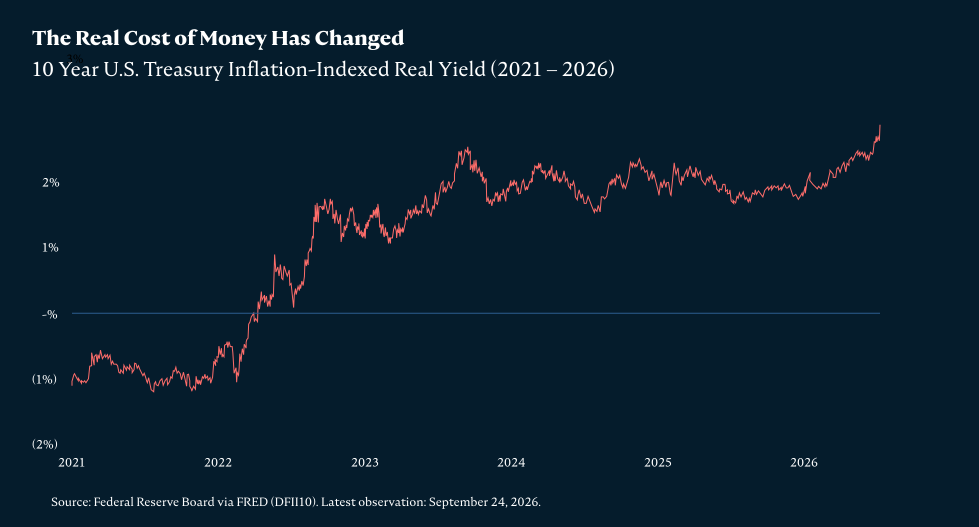
Capital has a price. And when governments, corporations, AI developers, manufacturers, and everyone else all want more of it at the same time, that price should go up. And that price is the interest rate.
The stock market and the bond market are not giving us contradictory signals. The economy is strong. Corporate activity is strong. AI spending is enormous. Businesses are investing. A recession doesn’t appear imminent. That explains the stocks. Add elevated inflation, enormous government borrowing and huge demand for capital, and it also helps explain why interest rates stay high. There is no single villain. It’s everything, everywhere, all at once bidding for the same capital. And as Druckenmiller told us, if the 30-year has to yield 5.5% to clear the market, that isn’t a crisis. It’s an invoice.
Some will tell you to stick with stocks. It’s what got us here, and TINA worked pretty well for a long time. Others are happy to sit in cash or bonds and wait for rates to come back down. They may be waiting a long time.
Cheap money should no longer be the base case. The forces holding rates higher are bigger than the next Fed meeting. Energy has a higher floor. The government is borrowing roughly $2 trillion a year with no obvious path toward shrinking the deficit. The AI buildout needs trillions more. That isn’t a bump in the road. It is the road. So stop planning around a 3% 10-year. Look for assets that can live with expensive money. Assets with cash flows that can adjust with inflation or rates. Assets supported by demand that does not disappear because the 10-year Treasury is at 5%. Power. Data. Manufacturing. Energy security. Supply-chain resilience.
The irony is that much of the new economy still depends on the old economy. AI needs power. Fabs need water and electricity. Manufacturing needs transportation and logistics. Resilience requires redundancy. Higher rates make all of those things more expensive to build. They do not make them less necessary.