The Price of Progress
3 minute read
October 20, 2026

Andrew Gillick
Managing Director, Director of Research
The Price of Progress
- Historic capex comparisons are misleading when nobody is counting the same thing
- Shale’s productivity gains are the cautionary tale for AI
- Capital discipline and an understanding of cycles matter more now than at any point in this buildout
We have all seen the claims. AI spending will be the biggest capital outlay in the history of technology spend far surpassing canals and railroads and highways and the internet and whatever else you want to throw in the bucket. But I think the headlines are confusing expectations with actuals. Land, power, permits, data centers, and chips all seem to be going into this AI capex bucket. Should we include memory fabs, too? Maybe. But the usual comparison of global spend by U.S. companies to U.S. GDP is probably wrong. The headlines are comparing a global AI forecast to historical U.S. numbers.
Regardless of the comparison, history tells us that all these outlays were technology driven and they all changed the way we lived. What sometimes gets forgotten is the gap between how a technology was expected to change the world and what actually happened. I think we have consistently underestimated how much it can do and how little it will ultimately cost.
In all these examples and on a smaller scale throughout my career, the technology was created to close a physical arb, increasing the speed with which something could travel. The canals closed the gap between the farm and the port. The railroads changed the speed at which we could travel and move goods and the internet changed how fast we could move information. And for 18 months, the Pony Express moved news across the country, until the telegraph put them out of business.
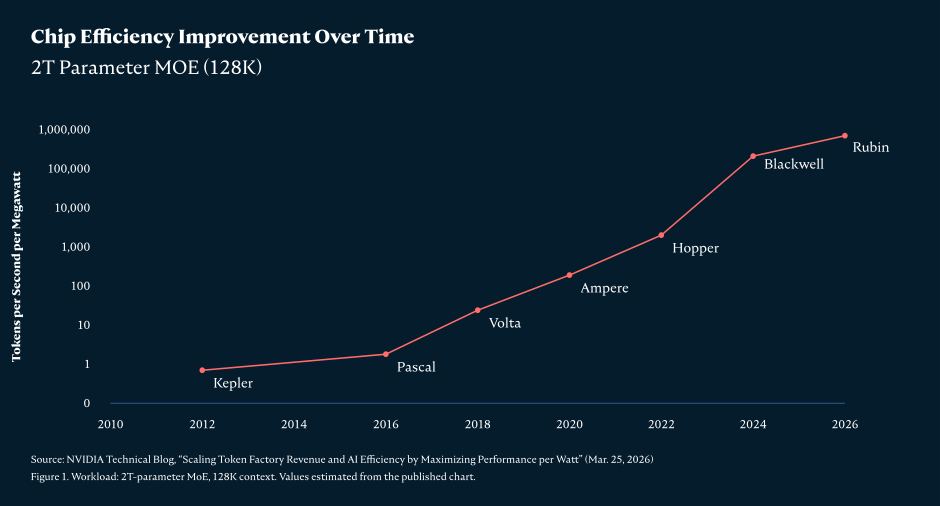
As a recovering shale analyst, I see major similarities in today’s AI tech revolution to the shale revolution of 15 years ago. Yes, shale was a tech revolution. How else can you explain the time to drill a well going from six weeks to six days with cost and productivity improving exponentially? The shale pioneers knew they could unlock more hydrocarbons, but few anticipated how efficient it would be and what it would do to the price of oil and gas. AI is on the same path. Three years ago, the best model on the market charged about $60 per million tokens. Today, the best model still charges $30 to $50 (depending on who you think is best), but an open weight model that is far better than the 2023 version charges about $1 per million tokens today. As we build out these data centers and chip efficiency improves (see chart below), cost per token will keep falling. The question will be, who keeps the rent?
In shale, the winners were rarely the upstream companies. The American people probably got the biggest dividend in low fuel prices and renewed global strategic relevance due to energy security. But after that, chemical companies benefited from cheaper feedstocks and pipelines loved the higher volumes as they collected their toll.
The market is concurrently trying to solve multiple physical bottlenecks to progress the AI revolution. Land, power, capital, memory and chips are all in short supply. So, the real question is, how do you avoid becoming upstream oil and gas? This is where location, price and development discipline matter. A site customers want to stay in as their equipment changes has a different investment case from one whose main attraction is that it has power today. Securing permits and a credible path to delivering that power before committing to construction reduces the number of things that need to go right. And what you pay determines how much future success you need, even if today’s scarcity premium fades.